
The short answer
A consumer unit (modern) is the better choice: expect to pay around £250–£600 to replace a fuse box with a consumer unit and have it installed and tested within a day.
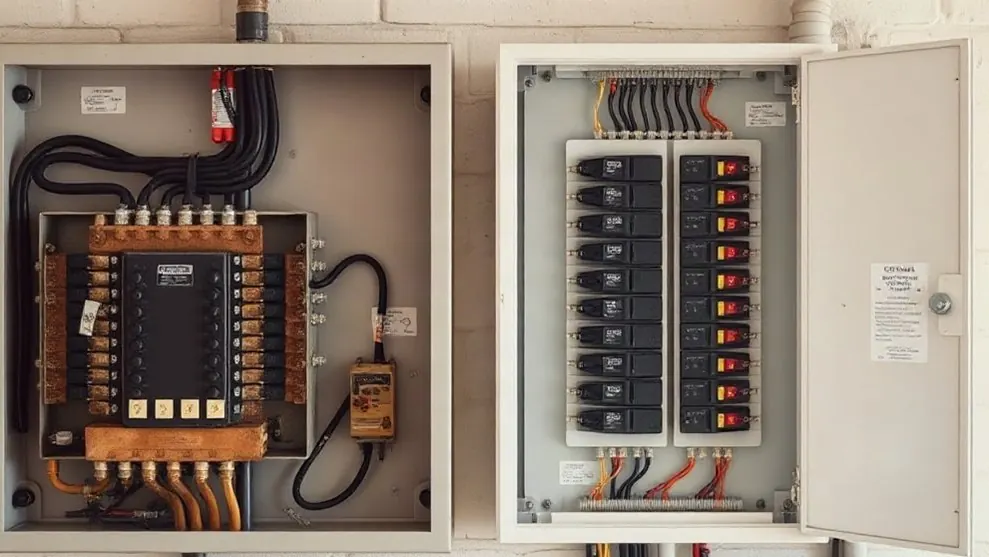
A fuse box is the older term for equipment that distributes electricity around a property; a consumer unit is the modern version fitted with circuit breakers and usually RCD protection. We use “fuse box” as older terminology because many existing installations still contain rewirable or cartridge fuses, whereas current consumer units are designed around resettable protective devices.
Practically, the distinction is protection, isolation and compliance with current electrical safety standards. A circuit breaker can be reset after a fault has been investigated; a fuse must be replaced with the correct rating. RCD protection monitors imbalance between live conductors and quickly disconnects supply where an electric-shock risk is detected. The safety implications depend on the installation’s condition, the protective devices fitted and the results of inspection and testing, not the label alone. We can assess this through appropriate inspection, testing and any necessary remedial work.
Why this happens
- Your lights dim or flicker when the kettle, oven or shower is turned on.
-
This usually means the old wiring or protective devices are struggling with higher-demand appliances.
-
Sockets or appliances suddenly trip the fuse or switch off when you plug something in or use a high-power device.
-
That often indicates the circuit is overloaded or the protective device is not up to current standards.
-
An socket or light switch feels warm or hot to the touch.
-
This commonly points to loose connections or deteriorating insulation causing excess heat.
-
You notice scorch marks, melting or discolouration around sockets, switches or the fuse box.
-
That usually means heat damage from poor connections or an overloaded or failing component.
-
Fuses or the consumer unit keep blowing or tripping without an obvious cause.
-
This can indicate worn-out protection, degraded components, or circuits not suited to modern loads.
-
The fuse box has old-fashioned ceramic fuses, rewireable fuses, or no RCDs/RCBOs, and wiring looks dated.
-
That typically means the installation is to an older standard and may lack modern safety features.
-
A buzzing, crackling or arcing noise comes from a socket, switch or the fuse box.
-
This usually suggests loose or damaged connections that need immediate attention.
-
Some circuits don’t have clear labels and you’re unsure what switches control which areas.
-
That often reflects an older installation that hasn’t been updated or properly maintained.
-
You’ve had additions like a home charger, electric shower or more sockets added over time and problems started afterward.
-
That commonly means the original circuits weren’t designed for the increased electrical demand.
-
Insulation around wiring looks brittle, cracked or exposed when inspected.
- This usually indicates age-related deterioration and reduced electrical safety.
If you experience any of these, it’s sensible to get a qualified electrician to assess the installation.
What to check first
Before touching the consumer unit, check for immediate danger: burning smells, heat, buzzing, scorch marks or repeated tripping. If any are present, do not remove covers, do not reset devices repeatedly and do not touch exposed metalwork. Keep people away, unplug appliances only if it can be done safely, and use the isolation switch only if it is clearly identified and accessible without risk.
Next, note which circuits have lost power, whether lights dim when appliances run, and whether sockets, switches or cables show damage. Check for water ingress, particularly after leaks or flooding, but do not handle damp electrical equipment. Identify whether the installation has rewirable fuses, circuit‑breakers or RCD protection. Visible age alone does not confirm condition; wiring integrity depends on testing, connections, insulation condition and correct earthing.
Note on legal duties and common misconceptions: it is incorrect to assume ownership of a consumer unit or visible deterioration alone establishes a legal requirement to replace it; the actual duty is to ensure electrical installations are safe, which is determined by appropriate inspection and testing (for example, an electrical installation condition report), and any required works should follow current British Standards and Building Regulations.
When to call an electrician
Call a qualified electrician promptly if the consumer unit shows overheating, arcing, damage, water ingress, persistent buzzing or repeated tripping that can’t be traced to a single appliance. Do not remove covers, reset a device repeatedly or fit replacement fuses with incorrect ratings; isolate the supply only if it is safe to do so.
We will investigate signs of loose connections, insulation deterioration, overloaded circuits and RCD faults using appropriate test equipment. A burning smell, a hot consumer‑unit enclosure, electric shocks from metalwork or loss of essential circuits warrants an urgent response and you should arrange for an electrician to attend promptly.
If you believe a particular appliance is responsible, appliance testing can help determine whether its cable, plug or an internal fault is causing disconnection. With older fuse boxes or in properties with ageing wiring we can assess whether the installation appears safe and advise on any remedial work that may be needed.
Note on legal duties: it is commonly thought that homeowners must replace an unsafe installation immediately; in reality the legal duty is to ensure premises are kept safe so far as reasonably practicable — this may require arranging inspection and remedial work rather than instant replacement. Any specific legal obligations (for landlords, businesses or tradespeople) depend on the circumstances and relevant legislation, so seek tailored legal or regulatory advice if required.
What it costs to fix
What it costs to fix a fuse box or consumer-unit fault depends on the cause, the condition of the existing wiring and whether remedial work is limited to one circuit or requires replacement equipment. We’ll isolate, test and identify the fault before recommending safe repair costs or replacement options.
| Job | Price | What’s included |
|---|---|---|
| Fault finding | £80/hr | Testing, labour, VAT |
| Emergency fault finding | £120/hr | First-hour minimum, testing |
| EICR, up to 3-bed | £150–£250 | Inspection, report, certificate |
| Consumer unit replacement | £500–£700 | Parts, installation, testing, certificate |
Most faults are traced within one to two hours, but damaged cables, overheated terminals or failed protective devices can require further remedial work. Prices include parts, labour, testing, certification and VAT. They don’t include plaster repairs, decoration, asbestos removal, DNO supply-upgrade charges, or scaffold/access equipment.
What we see around Maidstone
Across Maidstone we encounter a variety of legacy electrical installations linked to particular neighbourhoods and housing types. In the Victorian terraces of Tovil and parts of the town centre — terraces built in the late 19th century — we commonly find Victorian-era wiring such as vulcanised india rubber (VIR) and other rubber‑insulated cables that have become brittle and may not function correctly with modern protective devices. In the post‑war suburban estates of Shepway, Park Wood and areas of Senacre, where many houses were built in the 1950s and 1960s, aluminium conductors are more likely to be present; these require careful termination and assessment of conductor condition before any new consumer unit is fitted.
When we survey properties in Maidstone we test earthing, bonding, insulation resistance, circuit loading and the visible condition of cables for the specific dwelling we are working on — for example, a 19th‑century terraced house in Mote Park Road or a 1950s semi in Park Wood — and base any recommendation for a consumer unit replacement on those local findings. We do not assume a modern consumer unit will remedy deteriorated wiring or inadequate earthing in an older Maidstone property.
In parts of the town close to the River Medway and in low‑lying parts of areas such as Allington and the riverside stretch near the Lockmeadow area, properties prone to river flooding receive particular attention for moisture damage, corrosion and compromised accessories after any flood event. For listed and other period buildings in Maidstone — for example, those in the conservation areas around the town centre and Brenchley Gardens — we plan electrical work to protect original fabric while bringing the installation up to current safety standards appropriate to the building’s age and construction.