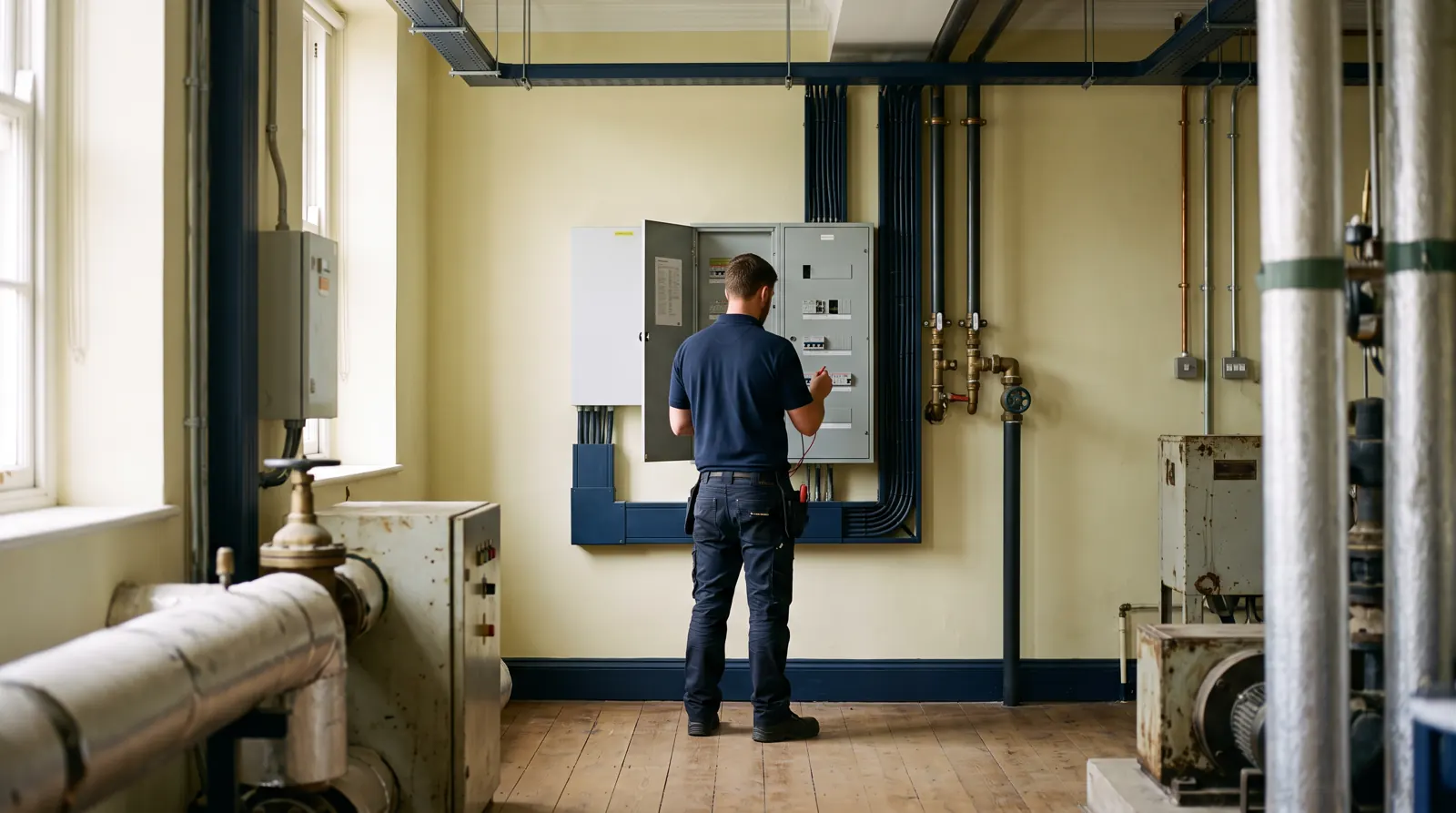

Three-Phase Machinery Connections
Before connecting three-phase machinery at the Maidstone premises, we assess the supply, motor and control requirements, protective devices, isolation, earthing and duty cycle to establish what follows. Subsequent sections outline checks for voltage, phase sequence and fault current, motor starting and control arrangements, safe rotation testing, load balancing, clear labeling, inspection and testing, and the certification needed for the completed work.
Our services
We provide methodical industrial electrical work across Maidstone, from the industrial estates on Penenden Heath and Kent Street to light-manufacturing units in the Lockmeadow area, with isolation, testing and safe commissioning built into every visit to these sites. - Machinery connections and three-phase fault finding for businesses on the A229 industrial corridor and units in the Parkwood and Barming Road trading estates - Clear fixed-price scope, compliant materials and verification tailored to commercial premises in Maidstone town centre and the riverside Lockmeadow complex - Electrical certificates and required notification for factories and workshops housed in red-brick Victorian and post-war industrial buildings common around the St Peter’s and Fant areas We’ll confirm what your Maidstone installation needs before work begins, specifying requirements for properties such as older Victorian mills converted to light industry near the River Medway or post-war industrial units off the A26, so documentation and compliance aren’t left to chance.
The jobs we are called for most
From planned maintenance to urgent fault-finding, we handle the industrial electrical work that keeps Maidstone premises safe, compliant and operational. We’re commonly called to investigate tripping circuits, overheating terminations, damaged containment, three-phase supply faults and machinery isolation issues. For workshops, warehouses and production areas, we install and alter distribution equipment, submains, control wiring, industrial sockets, lighting and emergency lighting.
We also trace intermittent faults affecting motors, pumps, compressors and process equipment, working methodically to identify the cause without compromising safety. Older premises can present specific risks, including Aluminium wiring in post-war installations and deteriorated Rubber cabling in period buildings. Where equipment changes or loads increase, we assess capacity, protective devices and earthing arrangements before completing necessary upgrades. For breakdowns, we prioritise safe isolation, restoration and clear fault diagnosis.
What is included in every job
Every industrial electrical job starts with a site assessment, safe isolation where required and a clear scope of work. We identify the affected circuits, machinery interfaces, distribution equipment and operational risks before commencing. Our engineers confirm access arrangements, permit requirements and isolation points with your responsible person.
We provide safety briefings for relevant personnel, establish controlled work areas and use appropriate test equipment to prove circuits dead before contact. Throughout the work, client liaison keeps you informed of progress, planned interruptions and any condition that could alter the agreed method.
We install, repair or modify equipment methodically, checking containment, cable routes, terminations, earthing and protective measures as applicable. Before leaving, we carry out functional checks, remove temporary controls, restore supplies safely and leave the work area orderly. Fixed pricing is agreed in writing before work begins.
Certificates and notification
Once testing and verification are complete, we issue the appropriate electrical certification for the work undertaken, such as an Electrical Installation Certificate, Minor Electrical Installation Works Certificate or EICR. The certificate records the installation details, inspection schedule, test results, departures from BS 7671 and any observations requiring attention.
Our certification process confirms that circuits, protective devices, earthing and bonding have been assessed before equipment is returned to service. We provide documentation promptly for your maintenance records, insurers, dutyholders and future alterations.
Where work is notifiable under Building Regulations, we follow the relevant notification procedures and submit details through the correct route. For industrial premises, notification requirements depend on the scope, location and authority having jurisdiction. We’ll explain what applies before work starts, retain records, and make certain you receive clear evidence of compliance.
What it costs
We provide fixed written quotes for industrial electrical jobs after a free survey that assesses load, circuit condition, access, isolation and testing needs. Below are typical charges and what each covers.
| Job | Price | What's included |
|---|---|---|
| Planned electrical labour | £80 per hour | Labour, testing and certification where applicable |
| Full-day attendance | £600 | Labour, testing and certification where applicable |
| Emergency attendance | £120 per hour (first hour minimum) | Labour, testing and certification where applicable |
| Commercial EICR | £30–£50 per circuit | Inspection, testing and certification |
Exclusions: DNO supply-upgrade charges, asbestos removal, scaffold or access equipment, plaster repairs and decoration.
How long each job takes
Alongside the fixed written price, we’ll give you a realistic programme for the work, including isolation, testing and certification time. We plan around safe shutdown windows, lock-off procedures and production priorities, so you’ll know what’s required before work begins.
| Typical task | Allowance |
|---|---|
| Fault finding and repair | 2–6 hours |
| Three-phase distribution alteration | 1–2 days |
Straightforward machinery connections may be completed within a shift, subject to cable routes, protective-device suitability and access. Larger installations need staged isolation, containment work, termination, inspection and energisation checks. Load testing follows installation where appropriate, confirming circuits perform safely under expected demand. We’ll also allow time for records, labels and certificates.
If operatives require site induction or Safety training, we’ll schedule this before electrical work starts. Emergency breakdown attendance is prioritised, but permanent repairs depend on diagnosis and parts availability.
Property types we work on around Maidstone
We work across Maidstone’s industrial estates — from the industrial units in Parkwood and the warehouses off New Cut Road near the town centre to the light-manufacturing units on Eureka Park — tailoring every installation or repair plan to the specific building’s supply capacity, machinery load, earthing arrangement and operational constraints found in those locations. In Tovil we regularly assess distribution routes and isolation points for factories and paper-processing sites on the River Medway, while in Grove Green we factor access requirements for small workshops and the effect our work may have on ongoing production in family-run manufacturers before starting.
In Vinters Park and the suburban terraces around Barming we support mixed-use and older sites, including converted Victorian terraces in the Maidstone town conservation areas where legacy VIR or rubber cabling may remain, and listed buildings around the High Street that require careful containment routes and minimal disturbance to historic fabric. On post‑war council estates such as parts of Shepway we encounter aluminium wiring in houses built in the 1950s and 1960s, while in newer industrial estates on Hermitage Lane and east of the A249 we often find units that have expanded machinery beyond their original design load. Whether you operate a distribution depot near Jubilee Way, a workshop in Downswood or offices in central Maidstone around King Street, we’ll identify defects specific to those areas, confirm safe working arrangements for the local infrastructure and plan disruption around your operations.
Certificates you will receive
Once the work is complete, we’ll issue the certificate that matches its scope: an Electrical Installation Certificate (EIC) for a new circuit or consumer‑unit replacement, and a Minor Electrical Installation Works Certificate for an addition or alteration to an existing circuit. Each document records the installation details, inspection results, safety testing and any limitations, providing a clear compliance record for your files.
Where work is notifiable under Part P — for example new circuits, consumer‑unit replacements and some installations in special locations — we can self‑certify through our NICEIC registration and, where applicable, notify Building Control on your behalf. You do not always have to arrange a separate Building Control inspection in those cases, but the legal duty to notify may rest with the person carrying out the work or the homeowner depending on circumstances; we will confirm who is responsible before starting. For condition assessments we issue an Electrical Installation Condition Report (EICR) rather than an installation certificate. Keep all paperwork with your maintenance records: it supports planned servicing, fault tracing, electrical guarantees and future alterations.
Areas we cover from Maidstone
From our base at Eclipse Park, Maidstone ME14, we provide industrial electrical services across Maidstone town and the immediate neighbourhoods of Bearsted, Penenden Heath, Tovil, Barming and Loose. In Maidstone town centre we attend retail workshops and light industrial units in the riverside trading estates; in Bearsted we service small industrial estates and farm-conversion workshops dating from late 19th–early 20th century stock; on Penenden Heath we work at older municipal and commercial premises near the A229 and at newer post‑war light industrial units; in Tovil we cover paper‑mill‑site redevelopments and riverside warehouses converted from 19th‑century mill buildings; in Barming we attend distribution depots and 1960s–1970s industrial terraces close to the railway; and in Loose we support mixed‑use sites and small engineering workshops in buildings ranging from Victorian cottages to later industrial sheds.
We plan our attendance in Maidstone around the local operating hours, site access arrangements and specific site safety procedures at the particular premises we will visit — for example, arranging early access for Depot Road distribution centres in Barming, coordinating with the estate managers on the Loose Valley industrial area, or following the permit-to-work systems used by larger tenants on the Penenden Heath business parks. Before work begins at any of these Maidstone locations we assess the premises’ isolation points, distribution arrangements, three‑phase supplies and any interfaces with machinery typical for the area — such as packaging lines at riverside warehouses in Tovil or machining centres at small engineering units in Bearsted. Our engineers carry out work methodically on site so as to minimise disruption to the local businesses in Maidstone, maintain safe segregation, and complete the testing and verification required by the specific premises type. Where access is restricted on particular sites around Maidstone — for example gated industrial estates in Loose or timed loading bays at Maidstone town centre retail units — we’ll coordinate our visit with the site contact so electrical work is completed safely and efficiently.