
The short answer
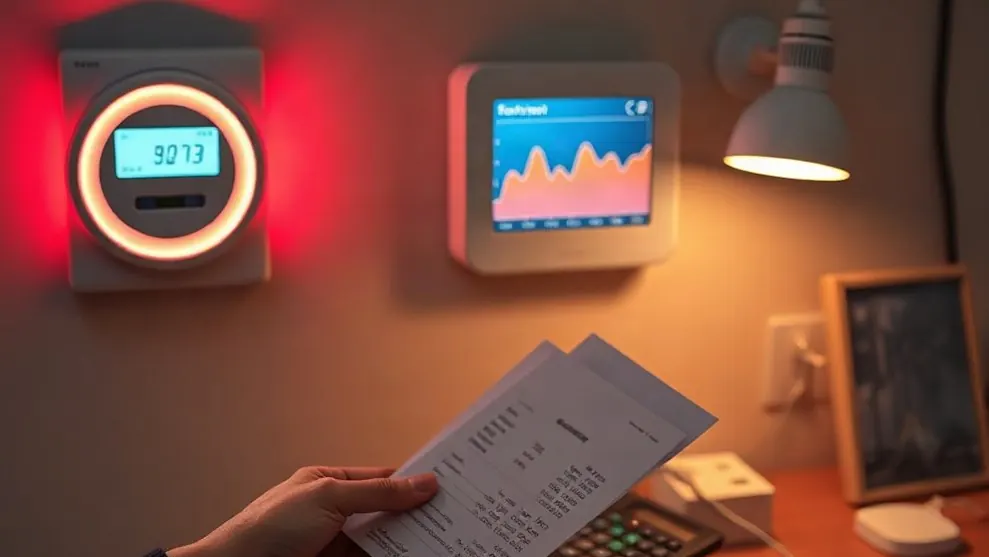
A smart meter (typically free via your supplier) records gas and electricity and sends readings automatically; an energy monitor (around £40–£150) shows real‑time electricity use — neither cuts consumption on its own, savings come from our actions after seeing the data.
For most households, a smart meter is the practical starting point because it improves billing accuracy and supports clearer bill forecasting. An energy monitor can add value if we want immediate, room‑by‑room awareness of electricity use, helping us identify costly habits such as leaving appliances running unnecessarily. However, it usually won’t show gas use in the same useful detail. We’d prioritise a smart meter for reliable readings, then use an energy monitor if real‑time feedback would help change daily routines and reduce electricity costs.
Why this happens
- Your smart meter shows a big jump in the half-hourly bill but your in-home display only ticks up slowly and looks low.
-
This usually means the billing meter records consumption in larger intervals, while the display updates more roughly or with a delay.
-
Your in-home display tells you the cost is high right now but you can’t tell which appliance is causing it.
-
This usually means the display gives a broad, near-live estimate but doesn’t identify individual devices.
-
You notice a clear spike on an energy monitor the moment you switch on the kettle, oven or hairdryer.
-
This usually means the monitor detects sudden changes in power draw when an appliance starts.
-
You can’t link the numbers on the display to your actions unless you watch them exactly when you turn something on.
-
This usually means you need immediate feedback to see cause and effect; delayed or averaged readings hide short events.
-
The display prompts you to change behaviour for a few days, then you stop looking at it and go back to old habits.
-
This usually means novelty wears off and the device alone doesn’t enforce lasting changes.
-
You see a drop or odd reading sometimes that doesn’t line up with what you think you used.
-
This usually means measurement inaccuracies or the way data is averaged can misrepresent short-term usage.
-
You save money only when you deliberately change actions — like shifting laundry to off-peak, unplugging standby devices, or lowering heating — not just by having the gadget.
- This usually means the device informs choices, but actual savings depend on the decisions you make.
What to check first
Before buying anything, check what information you already have: your supplier’s smart‑meter app or in‑home display, half‑hourly usage data, tariff details and the appliances most likely to create peaks. Compare high‑use periods with cooking, electric heating, tumble‑drying, charging and immersion heating to see whether changing habits could cut costs before you spend on another device.
Check meter readings against bills to confirm they’re accurate, and make sure your tariff rewards off‑peak use if that’s when you can shift demand. An energy monitor is most useful where appliance‑level clues are missing, not where a smart meter already reveals clear patterns.
For older Maidstone homes, especially Victorian terraces or post‑war properties, visually inspect wiring and accessories for obvious damage only where safely accessible. Note: you are not required to sell or install any particular device, and any electrical work beyond simple, safe visual checks must be carried out by a qualified electrician in line with current UK wiring regulations.
When to call an electrician
Call an electrician if monitoring highlights unusually high or erratic electricity use alongside warning signs such as tripping circuits, warm sockets, burning smells, flickering lights or damaged wiring — these can indicate a loose connection, an overloaded circuit or deteriorating cable. Do not assume the monitor is wrong or repeatedly reset a tripping circuit; that may leave a hazard unaddressed.
Ask us to investigate when a particular appliance, room or time of day consistently coincides with abnormal demand. We can use circuit testing to help distinguish genuine high load from a wiring fault and to identify whether the issue appears to be in fixed wiring, a socket or an appliance. If plugs feel hot, faceplates are cracked or scorch marks appear, prioritise safety: switch off the affected circuit if it is safe to do so, avoid using damaged equipment, and contact the emergency line for immediate risks.
Legal note: it is commonly said that any electrical fault must be repaired by a registered electrician — while some work (especially that affecting the fixed electrical installation) should be carried out or certified by a competent, appropriately qualified person, the precise legal responsibilities depend on the type of work and local regulations; always follow building regulations and, where required, use a qualified professional.
What it costs to fix
If monitoring points to a genuine electrical fault, we’ll diagnose it first rather than recommend unnecessary work: fault finding is £80 per hour, with most faults traced within one to two hours. That identifies whether repair costs are modest or a larger upgrade is justified.
| Job | Price |
|---|---|
| Extra socket | £55–£75 |
| Consumer unit replacement | £500–£700 |
| Partial rewire | £1,200–£3,000 |
| Full 3-bed rewire | £4,500–£8,000 |
Prices include parts, labour, testing, certification and VAT. They exclude plastering, decoration, asbestos removal, DNO supply-upgrade charges and specialist access equipment.
We’ll explain installation options and realistic replacement timelines before work starts, then provide a fixed written price. Our warranty details include a 12-month workmanship guarantee, so you can weigh the likely energy-saving benefit against the cost.
What we see around Maidstone
Across Maidstone we find that higher energy use often relates to how households in specific neighbourhoods operate rather than to an immediate electrical fault. In the Victorian terraces of Tovil and parts of the town centre — terraces largely built in the late 19th century — we commonly see old fabric and century‑old wiring that may need a careful assessment, but that alone does not automatically explain a high bill. In these terraced houses we recommend fitting a plug‑in monitor to identify costly appliances, electric heaters or standby loads before assuming a full rewire is required.
In the post‑war estates of Shepway, Park Wood and Senacre — areas with many 1950s–1970s semi‑detached houses and council properties — aluminium wiring and older fuse boards are more likely to be present and deserve professional attention at connections. Even in those estates, though, we still use a smart meter and appliance monitoring to separate safety work from routine consumption issues.
For Listed and conservation properties in Maidstone, such as older town centre buildings around All Saints and some historic houses in Barming and Loose, period rewires require careful planning to preserve finishes and to follow conservation‑area guidance; routeing cables sensitively can increase cost and complexity. Our usual approach across Maidstone is to start by gathering usage data from smart meters and plug‑in monitors specific to the property, then investigate any persistent electrical problems in the identified neighbourhood and property type rather than assuming a rewire will reduce bills.