What this job involves and what it costs
Energy monitoring services measure real-time and historical electricity use; pricing starts at £80/hour plus equipment for a basic whole-home monitor, with fixed quotes for circuit-level work. Serving Maidstone and surrounding areas including nearby villages and suburbs. All installations are fully certified and backed by a satisfaction guarantee, with professional testing, safe isolation procedures and written pricing provided before work commences.
When you need it
- Your bills suddenly jump even though you haven’t changed how you use appliances.
-
This usually means there’s higher or unexpected demand somewhere in the property that simple meter readings aren’t showing.
-
The heat pump seems to start at the worst times — the house trips breakers or other appliances cut out when it kicks in.
-
This often indicates two big loads are running together and exceeding what the wiring or consumer unit can comfortably handle.
-
The EV charger pulls a lot of power overnight and the water heater or immersion seems to run at the same time.
-
That typically means multiple high-draw devices are coinciding, increasing overall demand and potentially causing overloads.
-
Lights dim or flicker when you turn on the oven, shower or kettle.
-
This usually points to a large appliance drawing a big surge of power that drops voltage elsewhere on the same circuit.
-
A particular socket or circuit keeps tripping its breaker during workshop or tool use.
-
That generally shows the circuit is being pushed beyond its expected load or has an intermittent overload.
-
Some appliances run longer or seem to cycle more often than you’d expect.
-
This can mean base load or run-times are higher than assumed, adding steady consumption you might not notice.
-
You get unexpected power warnings or your consumer unit seems close to capacity when adding new equipment.
-
That usually means the existing wiring or consumer unit needs checking to see if upgrades or load balancing are required.
-
You can’t tell which device is causing the problem because the smart meter only shows the whole house number.
- That typically means you need per-circuit monitoring to find the specific high-load sources and fix them efficiently.
What it costs in Maidstone
For energy monitoring in Maidstone we provide a free survey and then quote per job because costs depend on circuits, consumer-unit layout and any additional wiring or load-management equipment required. We give a fixed written price before work starts so your bill will not exceed the quoted amount.
| Job | Price | What's included |
|---|---|---|
| Energy monitoring | Quoted per job | Parts, labour, testing, certificate, VAT |
| Fault finding | £80/hr | Diagnosis; most faults traced in 1–2 hours |
| Consumer unit replacement | £500–£700 | Parts, labour, testing, certificate, VAT |
Not included: plaster making-good, decoration, asbestos removal, DNO supply-upgrade charges, scaffold or access equipment.
What is involved on the day
We survey your consumer unit and supply arrangement, then isolate circuits safely before fitting the monitoring equipment. We install the sensors and communications hardware, test readings against the supply, and confirm that your existing circuits operate correctly. We issue the relevant certificate and keep the agreed written price unchanged.
Survey and isolation
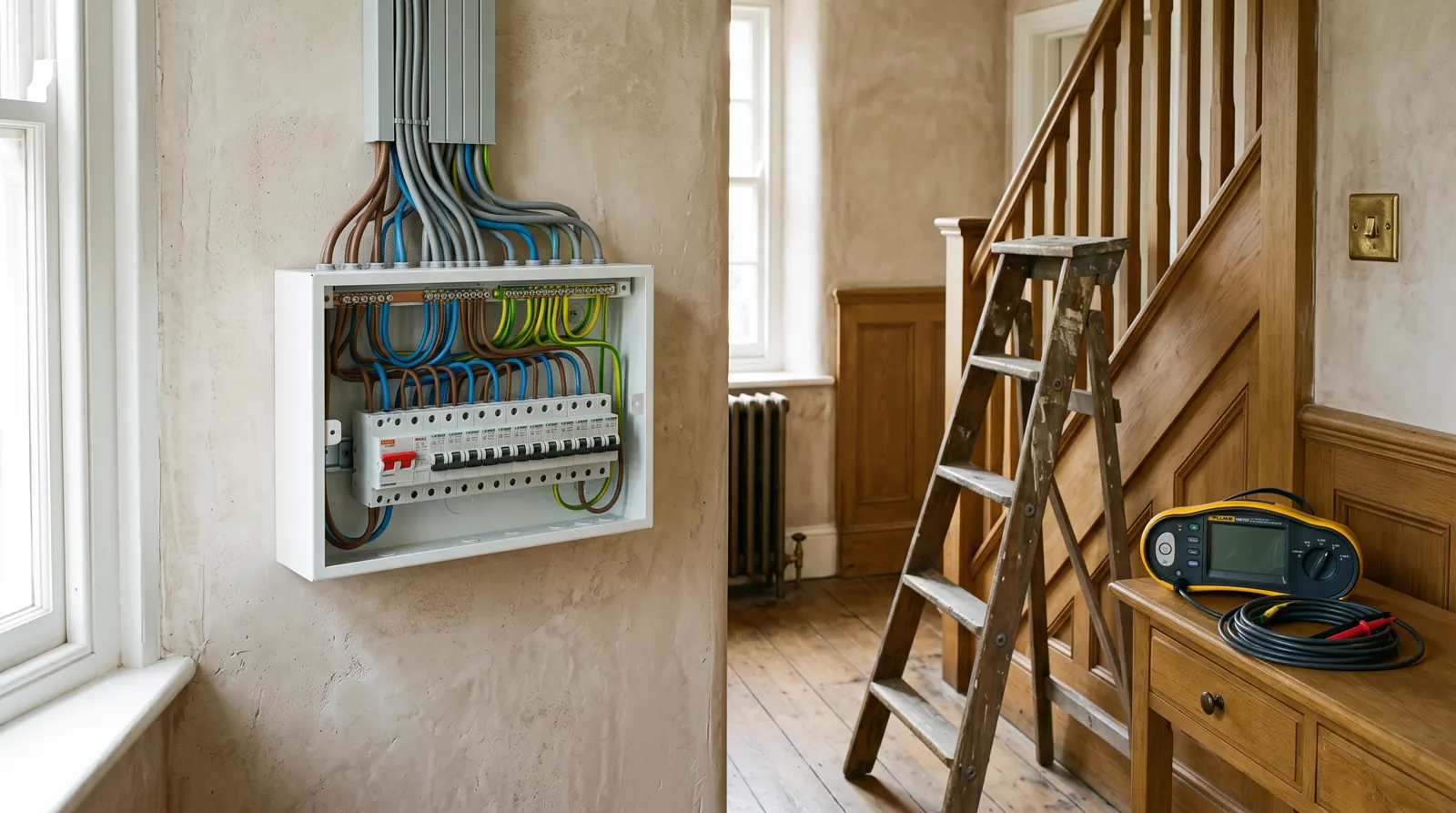
Before fitting energy-monitoring equipment, we survey the consumer unit, identify the relevant circuits and confirm where current transformers or meters can be installed safely. We compare circuit schedules with visible cable routes, check available enclosure space and assess whether existing labelling supports accurate monitoring. Our survey hazards check covers damaged insulation, overcrowding, aluminium wiring in some post-war homes and older VIR or rubber cable in period properties.
We then explain the isolation procedures required for the proposed supply and confirm whether a planned shutdown will affect heating, refrigeration, alarms or business equipment. Where safe isolation cannot be verified, we’ll identify the corrective work and price it separately. This assessment limits unplanned labour: our £80 hourly rate applies only where additional investigation is authorised. You’ll receive a fixed written quote before work starts, including VAT, labour and any required certification.
Installation
On installation day, we’ll isolate the agreed supply, fit the specified current transformers, meter or gateway, then connect it to the chosen display or app. We’ll mount equipment where cable routes, signal strength and access permit, typically beside the consumer unit, without obstructing covers or labels. Clamp sensors are sized and positioned around the relevant live conductors; three-phase supplies require sensors on each phase. Where appliance tracking is specified, we’ll install compatible sub-metering or configure circuit-level monitoring within the quoted scope. We can also integrate smart thermostats where the selected platform supports them, using the manufacturer’s approved connection method. Installation labour is included in your fixed written quotation, alongside agreed equipment and VAT. If concealed wiring, unsuitable enclosure space or additional circuits alter the scope, we’ll explain the cost before proceeding.
Testing
Once installation is complete, we’ll test each current transformer, meter or gateway against the live supply and confirm that readings are assigned to the correct phase, circuit or appliance. We compare displayed load with measured current using calibrated instruments, checking direction, polarity and communications where applicable. Meter testing includes verifying import/export data, pulse outputs and app or dashboard updates, so you’re not paying for misleading consumption figures.
Where monitoring connects within a consumer unit, we’ll confirm protective devices operate correctly and that added components don’t affect existing circuits. Insulation testing may be required where wiring has been altered or a fault is suspected; it identifies leakage that could distort readings or cause nuisance tripping. Testing is included in our written fixed price, with no separate call-out charge added after installation. We’ll also check data refresh intervals and identify any circuits requiring further investigation.
Certificate
After testing, we’ll issue the appropriate electrical certificate for the work completed, typically a Minor Electrical Installation Works Certificate for monitoring equipment added to an existing circuit or an Electrical Installation Certificate where the installation is more extensive. This compliance documentation records the circuit details, protective device rating, earthing arrangements, test results and any limitations affecting the monitoring installation.
We’ll give you the certificate electronically or in print, alongside manufacturer information for the monitor, app and current-transformer sensors. It confirms that the new work has been tested against BS 7671 requirements, not that unrelated existing wiring has been fully assessed. Certificate costs are included in our written fixed price, with no separate administration charge. Keep the installation certificate with your consumer unit records, especially if you later extend the system, arrange an EICR or sell the property.
Options and what we recommend
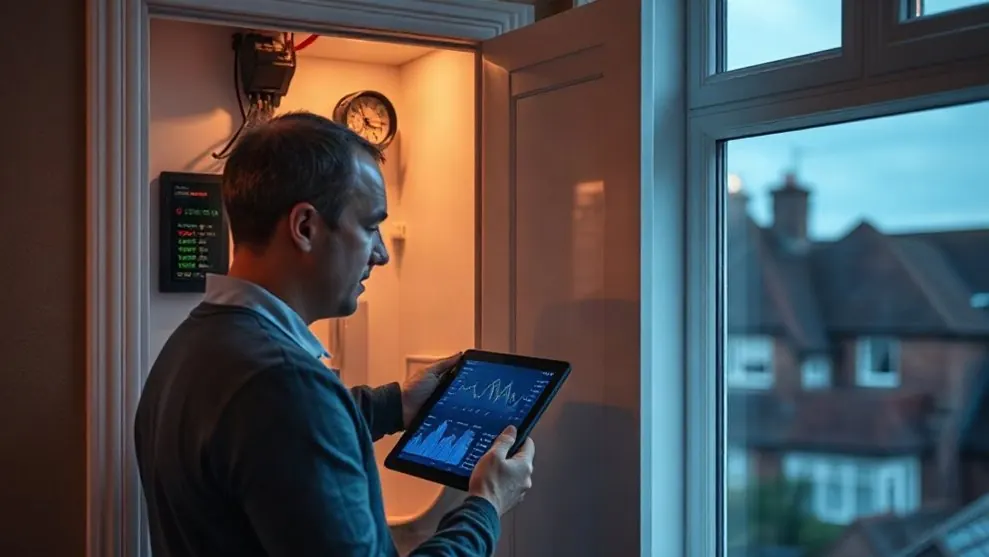
For most Maidstone homes and small businesses, we’d recommend starting with circuit-level monitoring at the consumer unit: it shows which circuits drive demand without the cost and disruption of monitoring every appliance. Clamp sensors measure current by circuit, helping you separate heating, cooking, EV charging and general socket loads. Smart dashboards turn half-hourly data into actionable patterns, while tariff optimisation can shift flexible use to cheaper periods.
| Option | Best use |
|---|---|
| Whole-property monitor | Baseline consumption and export |
| Circuit-level monitor | Identifying high-load circuits |
Choose whole-property monitoring where a simple consumption total is enough. Choose circuit-level monitoring when bills are high, you’re adding a chargepoint, or you need to verify whether electric heating dominates demand. We’d only specify appliance-level plugs for portable, suspect loads; their coverage is limited. We’ll size the system around your supply, circuits and budget.
Rules and certificates
Although many energy monitors are non-invasive, the installation method determines what paperwork may be needed. Clamp-on monitors fitted within an existing consumer unit circuit can require a Minor Electrical Installation Works Certificate only if the work involves altering or adding wiring; we will confirm this before quoting so any likely electrical compliance costs are clear.
Installing a new dedicated circuit for monitoring equipment, or replacing a consumer unit, is normally notifiable under Part P of the Building Regulations; work in a bathroom or other special location can also be notifiable. As NICEIC-approved, Part P-registered electricians, we can submit notifications and self-certify qualifying work on your behalf, which can remove the need for a separate Building Control inspection (note: Building Control may still request information or inspections in some cases). You will receive an Electrical Installation Certificate for new circuits or consumer unit replacements; an EICR is a periodic inspection report and does not itself certify new installations. Our fixed written price covers applicable certification, parts and labour, with no uplift after work starts.
Older homes around Maidstone
Older homes around Maidstone need a cable-condition check before we specify energy monitoring, particularly the Victorian terraces in Tovil and the town-centre streets around Week Street and Gabriel’s Hill, where vinyl-insulated rubber (VIR) or early rubber-insulated wiring installed in the late 19th and early 20th centuries may remain. In older suburban parts of Maidstone such as Barming and High Street in East Farleigh, many semi-detached and terraced houses built between the 1880s and 1930s can also retain ageing insulation that becomes brittle with time. We’ll inspect the consumer unit, meter tails, earthing arrangement and accessible circuits in these Maidstone properties to confirm clamp sensors can be fitted without disturbing deteriorated insulation; in the town-centre terraces on Week Street and in some Tovil cottages, forcing access or moving conductors risks creating defects that would need remedial work first.
For Listed properties within Maidstone — for example the conservation-area houses around All Saints Street and the historic buildings near the Archbishop’s Palace — we’ll prioritise non‑invasive monitoring: fitting current‑transformer clamps within the consumer unit and using wireless data transmission to avoid unnecessary surface trunking or alterations to Kentish timber framing and historic plasterwork. Where records are absent or we suspect defects in a Maidstone three‑bedroom mid‑terrace (typical of parts of Fant and the Brook area, built c. 1900–1930), we recommend an EICR; locally we commonly see these inspections quoted at about £150–£250 for that property type. If a consumer unit in a Maidstone Victorian or interwar house lacks safe space or compliant protective devices, replacement we have arranged for similar properties in the borough typically costs in the region of £500–£700 including certification.
How long it takes and whether you lose power
Once the consumer unit and accessible wiring are confirmed suitable, most Maidstone energy-monitoring installations take 1–2 hours. We fit current sensors around supply conductors, connect the monitor, commission its readings and confirm that circuit data is reporting correctly. The quoted price covers labour, parts and commissioning, so you’ll know the cost before work begins.
A brief power outage may be needed where safe isolation is required inside the consumer unit, typically limited to the connection and verification stage rather than the full visit. We’ll identify this during the initial assessment and advise you before work starts. For effective downtime planning, we recommend scheduling outside home-working hours, pausing sensitive equipment and allowing time for routers, alarms and appliances to restart. If access is restricted, cable identification is unclear or remedial work is required, installation time and cost are agreed separately.