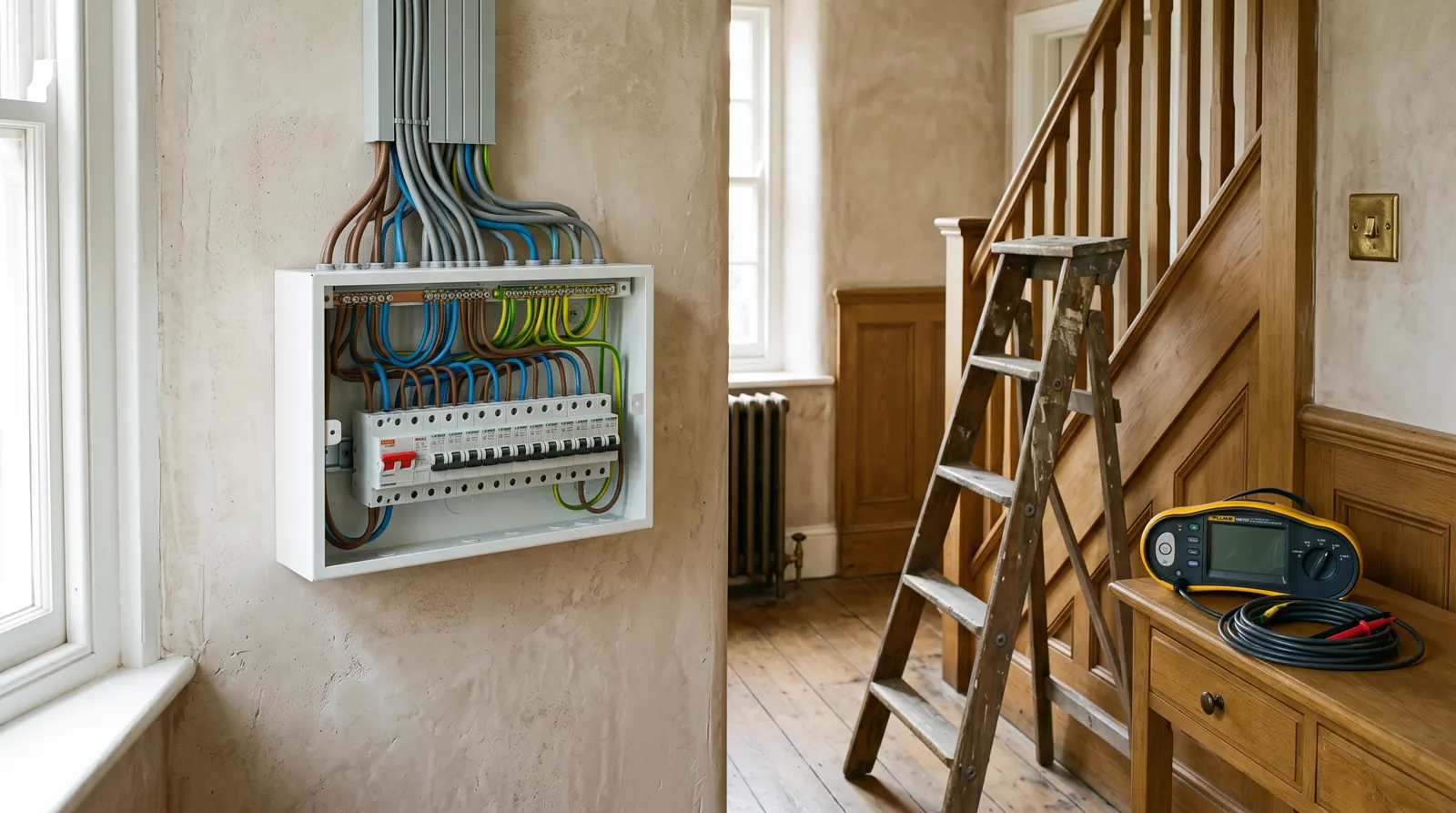

What this job involves and what it costs
Kitchen electrical work from single sockets to full appliance circuits, typically costing £55–£75 for an extra socket or £300–£500 for room downlights, with larger upgrades quoted. Serving Maidstone and surrounding areas including Victorian terraces and post‑war neighbourhoods. All work is fully certified, tested, and guaranteed with a fixed written price before work begins.
When you need it
- Your lights dim or flicker when you switch the oven, hob or kettle on.
-
Usually means circuits are overloaded or an appliance needs a dedicated supply.
-
You notice sockets or switches feeling warm to the touch.
-
Often a sign of loose connections or deteriorating wiring that can overheat.
-
New lights or extra sockets trip the fuse or RCD as soon as they’re used.
-
Typically indicates circuit overloads, incorrect wiring or a faulty protective device.
-
You can’t add appliances where you want them because there aren’t any circuits or sockets nearby.
-
Usually means the kitchen needs additional dedicated circuits or sockets.
-
Lights near the sink don’t have proper covers or seem exposed to splashes.
-
Often means the fitting doesn’t have the right IP protection for zones near water.
-
You see old wiring types (cloth, rubber, aluminium) or brittle insulation behind sockets and switches.
-
Usually a sign of aging installation that should be inspected and likely replaced.
-
You smell burning plastic or see scorch marks around sockets or the consumer unit.
-
Commonly caused by overheating, loose connections or faulty equipment—risk of fire.
-
After changes, you’re told you might need to notify Building Control or Part P.
-
Means the work affects fixed wiring or consumer units and may legally require notification.
-
Your RCD trips randomly or nuisance trips when plumbing or heating appliances run.
-
Often points to earth leakage, shared neutrals or deteriorated insulation.
-
In older terraces or post-war houses, electrics feel unreliable or behave unpredictably.
- Usually down to worn components, outdated earthing/bonding or undersized consumer units.
What it costs in Maidstone
Below are typical kitchen electrical jobs and fixed prices for work carried out in Maidstone; each quote is given in writing and includes VAT, parts, labour, testing and certification. We’ll confirm compliance and any certificate needs before work starts.
| Job | Price | What's included |
|---|---|---|
| Extra socket | £55–£75 | Supply and fitting of an additional socket, VAT, parts, labour, testing and certification |
| Fault finding | £80/hour | Diagnostic work charged per hour, VAT, testing and written quote for repairs |
| Downlights, 6–8 | £300–£500 per room | Supply and installation of 6–8 downlights per room, VAT, parts, labour, testing and certification |
| Consumer unit replacement | £500–£700 | Replacement consumer unit, VAT, parts, labour, testing and certification |
| Emergency attendance | £120/hour (first-hour minimum) | Emergency call-out charged hourly with a first-hour minimum, VAT, testing and written quote for follow-up work |
| Partial rewire (typical) | £1,200–£3,000 | Partial rewire where existing circuits or protective measures aren’t suitable; VAT, parts, labour, testing and certification |
Not included: plaster repairs, decoration, asbestos removal, DNO supply-upgrade charges, scaffold or specialist access equipment.
What is involved on the day
We’ll survey the kitchen, confirm the agreed circuit arrangement and safely isolate supplies before work begins. We’ll install the required wiring, sockets, appliances connections and protective devices in line with Part P and BS 7671. We’ll then test the installation and provide the appropriate electrical certificate.
Survey and isolation
Before any kitchen electrical work begins, we survey the proposed layout, identify the existing circuits and confirm the condition of the consumer unit, earthing and protective devices. Our survey techniques include tracing circuit routes where practical, checking protective device ratings, evaluating cable condition and noting potential concealed services. In Maidstone’s older properties, we remain alert to VIR, rubber or aluminium wiring and any signs of previous alterations.
We agree the safe working area with you, identify equipment requiring continued supply and explain any temporary loss of power. Our isolation procedures follow safe-isolation principles: we isolate the relevant circuit or supply, secure it against reconnection, prove the tester, confirm dead, then re-prove the tester. We don’t rely solely on labels or switched-off controls. Any concerns affecting safety, compliance or the agreed scope are raised before work proceeds.
Installation
With the circuits safely isolated and the kitchen layout confirmed, we install the agreed cabling, sockets, cooker connections, lighting points and dedicated appliance supplies in the planned sequence. We coordinate with your kitchen fitter so appliance placement, worktop heights and cabinet positions leave safe, accessible connection points.
Where electrical upgrades are required, we route new circuits through suitable containment, protect cables from heat and mechanical damage, and maintain prescribed clearances from water, gas and ventilation routes. We fit back boxes, accessories and connection units at practical positions, allowing for integrated appliances, extractors and under-cabinet lighting. Cooker circuits and high-load equipment receive correctly sized cable and local isolation where required. In older Maidstone properties, we’ll also manage concealed cable routes carefully to minimise disturbance to original fabric, particularly in period or listed homes.
Testing
Once installation is complete, we test each kitchen circuit to confirm correct polarity, earthing, insulation resistance and protective-device operation. We isolate supplies where necessary, use calibrated instruments and check electrical continuity through protective conductors and ring circuits. This verifies that faults can disconnect safely and that exposed metalwork is properly connected to earth.
We also test RCD performance at the consumer unit, confirming disconnection times meet BS 7671 requirements. Socket circuits, cooker connections, lighting and fixed appliances are checked under appropriate conditions, with care taken around newly fitted units, splashbacks and worktops. If readings identify a fault, we investigate before the circuit is put into service. You’ll be asked to keep clear of the work area while testing is underway, as circuits may be energised and isolated several times. We leave the kitchen safe and operational.
Certificate
Following satisfactory testing, we’ll issue the appropriate electrical certificate for the kitchen work completed. For new circuits, consumer unit alterations or other notifiable work, this will normally be an Electrical Installation Certificate, supported by test results and, where applicable, Part P Building Regulations notification. Minor additions or alterations may receive a Minor Electrical Installation Works Certificate instead.
Your safety certificate records the work’s scope, protective devices, circuit details, inspection outcomes and measured results. Keep it with property documents; it provides evidence that the installation was inspected, tested and left safe for service. We’ll explain any observations and confirm what has been certified before leaving. Landlords should retain certificates alongside EICR records to support tenant compliance, particularly where kitchen alterations affect rented accommodation. Certificates do not replace future periodic inspection requirements.
Options and what we recommend
We’ll assess the existing kitchen circuits, earthing and consumer unit capacity before recommending the right arrangement for your appliances. We’ll identify ageing aluminium, VIR or rubber cable where relevant, then design safe, practical capacity for cooking, lighting and worktop use.
| Kitchen need | Recommended approach |
|---|---|
| Induction hob | Dedicated suitably rated circuit |
| Oven | Separate circuit where load requires |
| Worktop sockets | Ring circuits or radial circuits |
| Dishwasher and washing machine | Individual connections, balanced loading |
For most refurbishments, we recommend dedicated circuits for high-load fixed appliances, RCD protection and sufficient accessible sockets to avoid extension leads. Consumer units may need additional ways or upgrading where protective devices, fault capacity or condition are unsuitable. In older Maidstone properties, we’ll consider concealed routes carefully, particularly in period walls, while keeping circuits clearly arranged for future maintenance.
Rules and certificates
Kitchen electrical work may fall under Part P of the Building Regulations if it involves creating a new circuit, replacing a consumer unit or work in a special location such as a bathroom; we will assess the scope before starting and explain whether you or we need to notify Building Control. As an NICEIC-registered competent person we can self-certify certain notifiable work and, where applicable, notify Building Control on your behalf, but not all kitchen work is notifiable and you are not legally required to use a registered installer in every case.
You will receive an Electrical Installation Certificate (EIC) for a new circuit or consumer unit replacement, and where appropriate we will issue a Minor Electrical Installation Works Certificate for additions or alterations to existing circuits; these certificates record the tests carried out (protective measures, polarity, continuity and circuit performance) and should be kept with your property records.
Older homes around Maidstone
In Maidstone we take care when assessing older homes for kitchen alterations. In Tovil and the town centre, where many terraces date from the mid- to late‑19th century and some properties retain period fittings, we specifically look for VIR (vulcanised india rubber) or rubber‑insulated cable. In areas around Park Wood and Fant where there are clusters of post‑war semi‑detached houses built in the 1950s and 1960s, we also check for older aluminium conductors.
When working in Maidstone’s Victorian terraces in Tovil and the town centre we inspect accessible circuits, earthing and bonding, consumer unit protection and the condition of existing cables before connecting new loads such as ovens, hobs or dishwashers. In the 1930s and 1950s housing around Loose and Barming we are equally alert to brittle period wiring that may lack a protective conductor or be unsuitable for extension, and we do not assume these circuits are safe simply because they still operate.
If alterations in Maidstone properties — whether a listed Georgian terrace near the town centre, a character cottage in East Farleigh, or a 1960s semi in Park Wood — expose defects, we will explain whether targeted remedial work or full rewiring is appropriate and provide a fixed written price. When working in listed buildings and conservation areas around the town centre and historically sensitive streets in Tovil, we plan cable routes to protect heritage finishes while maintaining required safe zones, suitable containment and compliance with BS 7671. We will also check specifically for older aluminium conductors in post‑war homes around Fant and Park Wood.
How long it takes and whether you lose power
Once the existing installation has been assessed, we’ll confirm the programme and any planned isolation before work starts. Duration estimates depend on access, the number of new circuits, wall finishes and whether the consumer unit has spare compliant capacity. Replacing accessories or adding a socket may take a few hours; kitchen rewiring or a consumer-unit upgrade can require one or more days.
Power interruptions are usually limited to the circuit being altered, but we may need to isolate the whole installation for safe testing, connection work or consumer-unit changes. We’ll schedule this where practical, identify essential loads such as refrigeration, and restore supplies only after the required checks are complete. All new kitchen circuits are installed, tested and certified in line with BS 7671 and Part P notification requirements where applicable.