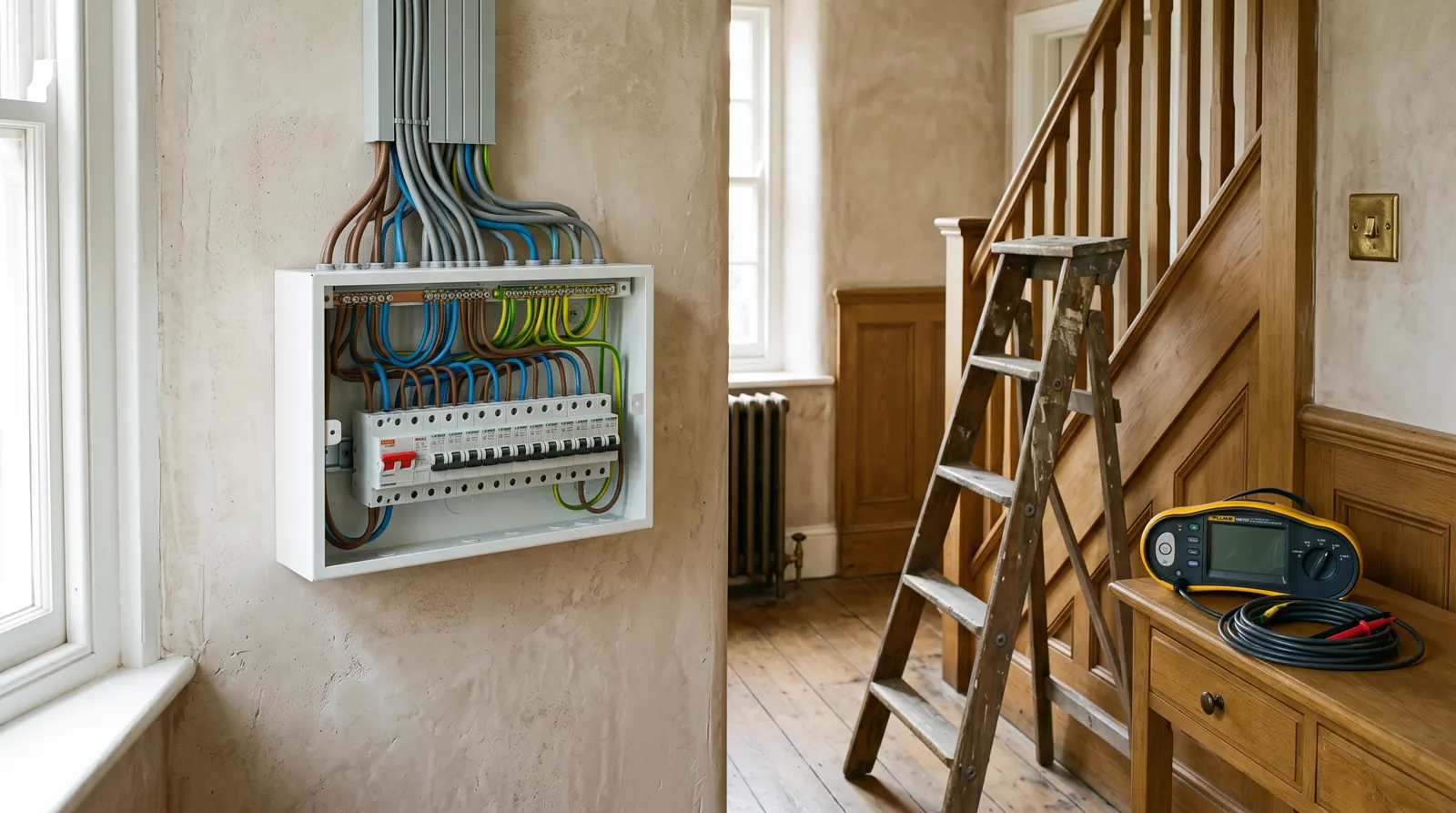

Does your Maidstone home actually need a rewire?
Not usually — most period or listed Maidstone homes need assessment rather than an automatic full rewire; we typically complete an EICR and written report within 3–5 working days from inspection, usually costing from £240.
We inspect the installation’s condition, protective measures, earthing and capacity before recommending proportionate work. Victorian properties may retain VIR or rubber‑insulated cable, while post‑war homes can contain aluminium wiring requiring careful evaluation. Rewiring isn’t the default solution: targeted upgrades, circuit alterations or partial rewires are often safer, less disruptive and more cost‑effective.
Our NICEIC‑approved electricians provide an EICR to document findings and identify appropriate works. We’ll consider a modern consumer unit, sympathetic heritage lighting and practical socket placement without compromising significant fabric. For listed buildings, we plan routes carefully and explain any work requiring listed building consent. You’ll receive a fixed written price before work starts, relevant certification on completion, and no pressure to specify unnecessary replacement.
Signs a rewire is due
- Your lights flicker or dim when you switch on the kettle or other appliances.
-
Usually means circuits are overloaded or connections are poor and struggling under load.
-
Your sockets or switches feel hot to the touch.
-
Often indicates loose or ageing connections that are overheating and unsafe.
-
Your fuses blow or your RCD/MCB trips for no obvious reason.
-
Usually a sign of a faulty circuit, earth leakage, or deteriorating insulation causing short or leakage currents.
-
Some sockets or lights don’t work even though the fuse/circuit breaker is fine.
-
Could be broken wiring, poor connections, or a damaged accessory that needs replacing.
-
You see scorch marks, burn stains or blackening around sockets, switches or light fittings.
-
Typically shows past overheating or arcing — a fire risk that needs immediate attention.
-
Wiring feels brittle, crumbly, or you see old rubber-covered cables in the loft or behind fittings.
-
Old rubber insulation degrades with age and can crack, exposing live conductors.
-
You’ve got shiny, silver-coloured wires (aluminium) or suspect older metal wiring in parts of the house.
-
Aluminium wiring can loosen and oxidise, causing poor connections and overheating.
-
New appliances trip breakers, won’t run properly, or sockets don’t provide enough power.
-
Suggests the house has too few circuits or insufficient capacity for modern electrical demand.
-
You get tingles or a small shock when touching appliances, or metal fittings feel “live”.
-
Indicates poor earthing or earth faults — potentially dangerous and needs fixing.
-
In older or period homes, wiring has been patched up or altered many times and cables are hidden in walls.
-
Concealed, altered wiring can be undocumented and unsafe; it often needs careful testing or replacement.
-
Your electrician used testing and explained your earthing or protective devices were below modern standards.
- Means parts of the system don’t meet current safety requirements and may need remedial work or a rewire.
What a rewire costs in Maidstone
Typical full rewires in Maidstone cost between £4,500 and £8,000 including VAT, parts, labour, testing and certification; we provide a fixed written price after survey so your bill won’t exceed the quote. Period or heritage work can cost more where fragile finishes, difficult cable routes or listed-building consent affect the specification.
| Job | Price | What's included |
|---|---|---|
| Full three-bedroom rewire | £4,500–£8,000 | VAT, parts, labour, testing and certification; fixed written price after survey |
| Partial rewire | £1,200–£3,000 | VAT, parts, labour, testing and certification |
| Consumer unit replacement | £500–£700 | VAT, parts, labour, testing and certification |
| EICR, up to three bedrooms | £150–£250 | Electrical inspection and certification |
Not included: plaster and decoration, asbestos removal, DNO supply-upgrade charges, scaffold or access equipment.
How long a rewire takes, room by room
Most room-by-room rewires in Maidstone take around five to ten working days for a typical three-bedroom home, but listed and period properties can require longer planning and installation time. We survey routes first, protecting Historic aesthetics and prioritising Cable preservation where safe.
| Area | Typical duration | Certified focus |
|---|---|---|
| Consumer unit | 1 day | Earthing and labelling |
| Kitchen | 1–2 days | Dedicated circuits |
| Bathroom | 1 day | RCD protection |
| Bedrooms/living areas | 2–4 days | Socket and lighting tests |
Older fabric, concealed voids, and consent requirements can extend timings. We’ll confirm a written programme after inspection, coordinate compliant cable routes, test each circuit, and issue the appropriate electrical certification when the installation is complete. Our NICEIC-approved electricians work to BS 7671, recording results so you receive a safe, traceable installation.
Living in the house while we work
While it’s often possible to remain in your Maidstone home during a rewire, we’ll agree a phased plan that keeps essential circuits available where safely practicable. Before work begins, we’ll confirm your living arrangements, access times and which rooms must remain usable.
We isolate only the circuits required for each stage, test before re-energising, and clearly identify any temporary limitations. You shouldn’t use damaged leads, extension reels or circuits we’ve marked as out of service. We’ll discuss safe provision for refrigeration, cooking, lighting and charging, but temporary supplies are never improvised.
Noise management includes agreeing drilling periods, protecting occupied areas from dust, and giving notice before disruptive work. Children, pets and vulnerable occupants must stay clear of work zones. On completion, we test the installation and issue the appropriate electrical certification.
Rewiring a period or listed property
Rewiring a period or listed property in Maidstone and its surrounding neighbourhoods — including the historic town centre, Allington, Fant, Loose, and Staplehurst Road terraces — requires a design that improves electrical safety without unnecessarily disturbing the borough’s historic fabric. When working in central Maidstone’s Georgian and early-Victorian townhouses, late-Victorian terraces in Fant and Loose, or the interwar and 1950s semis found around Allington and Park Wood, we inspect existing circuits, identify ageing VIR and rubber insulation commonly found in homes built before the 1960s, and plan compliant routes for modern cabling, earthing and RCD protection suitable for properties of those ages.
Before work in Maidstone conservation areas such as the High Street and Lockmeadow, or on listed buildings around Week Street and the area near the Archbishop’s Palace, we discuss local heritage materials, original features and any listed-building constraints that affect the electrical design. Our approach uses conservation techniques appropriate to Maidstone’s construction types, including careful route selection around lath-and-plaster walls typical of 18th- and 19th-century townhouses, joinery in the town centre’s Georgian properties, and decorative plasterwork found in older cottages and villas on Loose Road. When positioning switches and running cables in streets of timber-sash windows and original architraves — for example in the Stoneborough or Jubilee areas of the town centre — we aim to preserve architraves rather than treat original timber as disposable.
For period lighting in Maidstone properties — from ornate fittings in a listed Georgian house near the River Medway to more modest period-style lighting in late-Victorian terraces off Fant Lane — we can specify sympathetic accessories and controls that suit the local character while ensuring circuits meet current safety requirements. On completion of rewires in Maidstone and nearby settlements such as Allington, Boxley, and Hollingbourne, we test the installation, issue the relevant electrical certificate, and provide clear circuit identification tailored to the layout of that particular house for your records.
Making good, and what we do and do not put back
Before work starts, we’ll set out in writing what making good is included after cable routes, accessory changes and consumer-unit work in your Maidstone period or listed property. We’ll reinstate chased plaster to an agreed functional finish, securely refit accessible floorboards and leave work areas safe, tidy and ready for follow-on trades where needed.
Plaster matching is specialist work: lime, lath-and-plaster, ornate cornices, historic paint finishes and fragile tiles may require a conservation plasterer or decorator. We don’t promise invisible repairs where original materials, movement or previous alterations prevent this. Decorative restoration, wallpaper replacement, repainting, joinery repairs, bespoke mouldings and full floor refinishing aren’t included unless specifically priced. We’ll identify any fragile fabric before opening routes, minimise disturbance, and agree practical access methods with you before installation begins.
Certificates and Building Control
For a period or listed-property rewire in Maidstone, we’ll issue the correct electrical certification and handle Part P notification where the work is notifiable. New circuits, consumer-unit replacements, and electrical work in bathrooms or other special locations require notification under Part P.
As NICEIC-approved, Part P-registered electricians, we can self-certify eligible work and notify building control on your behalf. This avoids the homeowner arranging and paying separately for inspection through the local authority.
The certificate types depend on the scope. We provide an Electrical Installation Certificate (EIC) for new circuits and consumer units. For an addition or alteration to an existing circuit, we issue a Minor Electrical Installation Works Certificate. An EICR is different: it is an inspection report identifying the condition of an existing installation, not a completion certificate for rewire work.
Recent rewires near Bearsted
Alongside certification, we’ve completed period-property rewires near Bearsted where careful cable routing, sympathetic fittings and minimal disturbance are needed to protect original features. Before work begins, we assess accessible routes through floors, lofts and service voids, identifying unsuitable older cabling and planning safe upgrades without unnecessary chasing.
Our recent updates focus on practical decisions: retaining sound historic fabric, positioning sockets sensitively and selecting fittings that suit the room while meeting current safety requirements. We isolate circuits, test throughout the installation and issue the appropriate electrical certification on completion.
Homeowner experiences often centre on wanting modern capacity without losing character. We provide a fixed written price before starting, explain any options clearly and coordinate work stages to reduce disruption. Where listed-building consent is relevant, we’ll work carefully within the agreed scope.