What this costs and how fast we can help
From £80 per hour and usually within one to two hours for most fault finds, we give a fixed written price before any faulty-wiring repair begins. We’ll never charge more than the quoted amount.
We provide rapid response across Maidstone, with appointment availability 7am–6pm Monday to Saturday and a 24‑hour emergency line. Our booking process confirms call‑out times, access needs and safety priorities.
| Job | Price | What’s included |
|---|---|---|
| Fault finding | £80/hr | Labour, testing, VAT |
| Emergency attendance | £120/hr | First hour minimum, testing |
| Partial rewire | £1,200–£3,000 | Parts, labour, certification |
Most faults are traced within one to two hours. We isolate unsafe circuits where necessary and test repairs before re‑energising. Prices exclude plastering, decoration, asbestos removal, DNO supply‑upgrade charges, and scaffold or access equipment. You’ll receive certification where applicable, protecting your home and providing reassurance.
The faults we are called out for most
- Your consumer unit (fuse box) trips repeatedly.
-
Usually means a circuit is overloaded, has a short, or there’s earth leakage that needs investigating.
-
Some sockets or switches feel hot to the touch.
-
Usually caused by loose connections, damaged accessories, or overloaded circuits creating heat.
-
A socket or plug sparks or gives off a small flash when you plug something in.
-
Usually points to a poor connection or damaged wiring that’s arcing and needs attention.
-
Lights flicker when you switch on a heavy appliance (kettle, toaster, washing machine).
-
Usually a voltage dip from a high load on the circuit or a weak connection that needs fixing.
-
Power goes off to part of the house while the rest stays on.
-
Usually a tripped circuit or a loose/broken connection supplying that circuit.
-
You notice a burning or scorched smell near sockets, switches or the consumer unit.
-
Usually overheating caused by a bad connection or damaged cable — this is a serious warning sign.
-
Sockets or plugs are cracked, discoloured or look melted.
-
Usually indicates heat damage from overloading or faulty fittings that should be replaced.
-
Lights buzz or hum, especially dimmable fittings.
-
Usually a poor connection, incompatible fittings or a failing fixture causing instability.
-
Older wiring looks dated (cloth-covered, rubber-insulated or aluminium) or you find junctions behind skirting that look makeshift.
-
Usually means the wiring is aged or uses outdated materials and may need upgrading or proper connections.
-
You get tingles or small shocks from appliances or metal switches.
- Usually a sign of earth/insulation faults or a protective earth not working properly — needs immediate checking.
Safe checks to try before you call
Before calling us, you can make a few simple checks without removing covers, touching wiring or repeatedly resetting a tripping circuit. Use this safety checklist: unplug recently used appliances, especially heaters, kettles and chargers, then see whether the consumer unit remains stable. Check for visible damage to plugs, leads and sockets, scorch marks, heat, buzzing, burning smells or flickering lights.
If a socket is loose, hot or damaged, stop using it and keep the area clear. If water has entered electrics, switch off power only if it is safe to do so; otherwise, keep away and call us. Don’t replace fuses with incorrect ratings, remove consumer‑unit covers or rely on temporary fixes such as extension leads. Repeated tripping indicates a fault requiring proper diagnosis by a competent electrician.
Note on duties and common misconceptions: you are not legally required to carry out your own electrical repairs; in many situations it is sensible and often advised to engage a qualified electrician. Conversely, it is a misconception that resetting a tripping device repeatedly is an appropriate long‑term solution — repeated tripping should be investigated by a competent person to identify and fix the underlying fault.
Aluminium Wiring in Post-War Homes
Built extensively in the post-war period, Maidstone estates such as Shepway, Park Wood and Senacre may contain aluminium wiring, which needs careful assessment rather than assumptions. We’ll check conductor condition, terminations and compatibility with current protective devices.
| Issue | Risk | Appropriate action |
|---|---|---|
| Aluminium corrosion | Rising resistance | Inspect and remediate |
| Loose terminals | Heat damage | Re-terminate correctly |
| Mixed metals | Galvanic corrosion | Use approved connectors |
| Ageing accessories | Poor contact | Replace suitable components |
Aluminium expands differently from copper, so connections can loosen over time. We don’t simply tighten terminals: the work must comply with BS 7671 and manufacturer instructions. Where earthing arrangements are inadequate, bonding upgrades may be required. Depending on findings, safe remedial work can range from accessory replacement to partial or full rewiring, with certification where applicable.
How we trace a fault
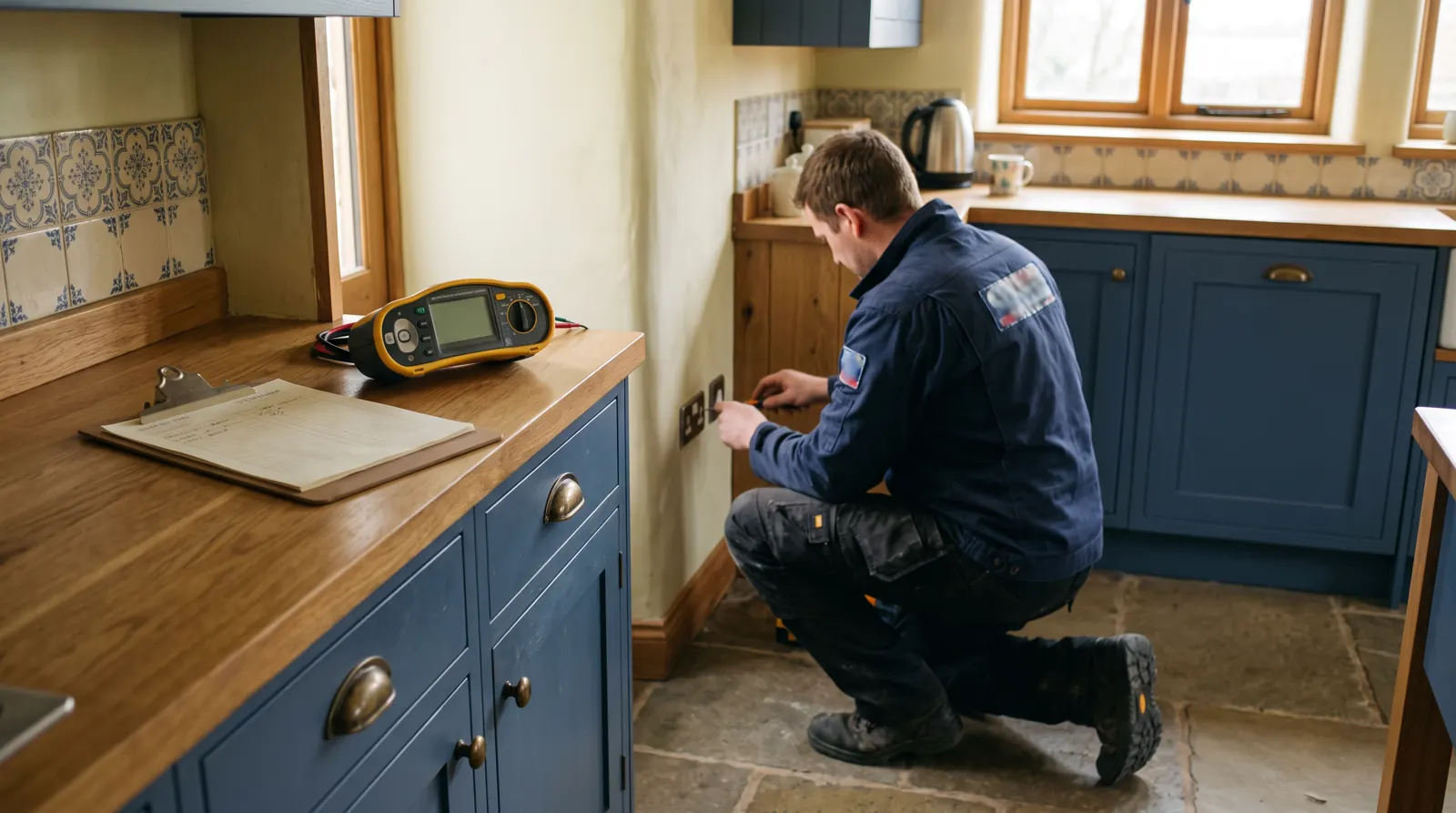
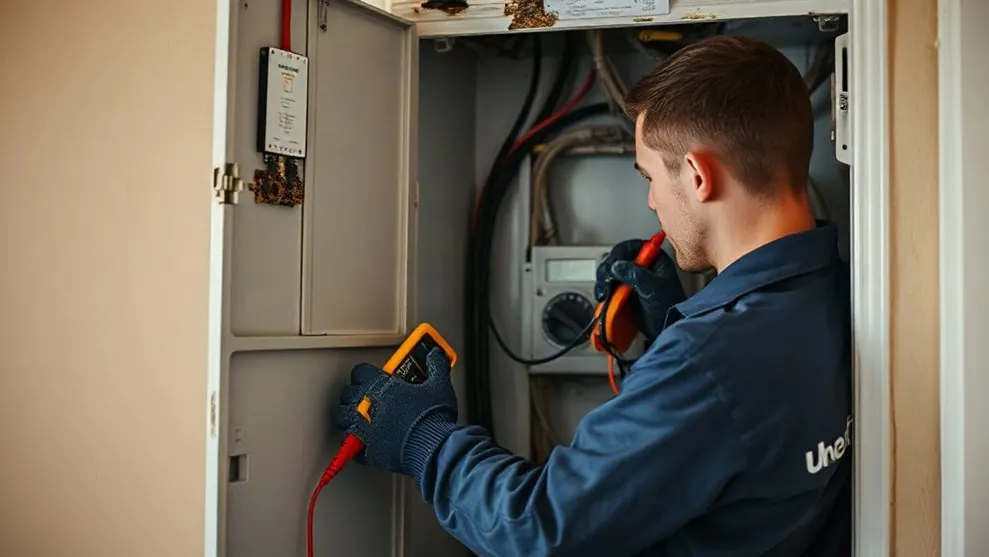
When tracing a fault, we first isolate the affected circuit where necessary and establish whether the issue lies with the supply, consumer unit, fixed wiring or an accessory. We verify dead conditions using approved test equipment before opening accessories or inspecting connections. Our electricians then carry out continuity, insulation-resistance and polarity testing, alongside earth-fault loop impedance checks where appropriate, in accordance with BS 7671 procedures.
Where cables are concealed, we use cable tracing to identify likely routes without unnecessary disturbance. Signal injection can help distinguish the correct cable from adjacent circuits and locate interruptions, provided the circuit is safely isolated and the method is suitable for the installation. We also inspect for loose terminals, heat damage, moisture ingress and ageing cable types. This structured approach identifies the fault while protecting you, the property and the installation’s integrity.
What it costs to put right
We’ll diagnose the fault and give a fixed written price before any work begins; labour is estimated at £80 per hour and most faults are traced within one to two hours. Prices include VAT, materials, testing and certification where required.
| Job | Price | What's included |
|---|---|---|
| Fault finding | £80/hr | Testing and diagnosis |
| Extra socket | £55–£75 | Parts, labour, testing |
| Partial rewire | £1,200–£3,000 | Compliant replacement wiring |
| Consumer unit | £500–£700 | Installation, testing, certificate |
| Full 3-bed rewire | £4,500–£8,000 | Parts, labour, certification |
Not included: plaster repairs, decoration, asbestos removal, DNO charges and access equipment.
When it is an emergency instead
Treat faulty wiring as an emergency if you smell burning, see smoke or scorching, receive an electric shock, observe sparking sockets or have a consumer unit that trips repeatedly. Arrange immediate evacuation where there is smoke, fire, overheating or a risk of electric shock. Do not touch damaged cables, wet electrical equipment, metalwork or a consumer unit that appears heat-damaged.
If it is safe to do so without approaching the fault, switch off the main supply at the consumer unit (this is emergency isolation). Never attempt repairs, remove protective covers or repeatedly reset protective devices. Call 999 if there is fire, smoke, injury or an immediate danger; you may then also contact our 24-hour emergency line. We will assess the installation, identify the fault, make it safe and, where required, complete any necessary certification. Keep everyone clear until a competent electrician confirms the circuit is safe.
Note on legal duties: it is commonly believed that homeowners must have an emergency electrician attend immediately in every fault; that is not a blanket legal requirement. The legal duty is to take reasonable steps to prevent danger (for example evacuating premises, isolating the supply if safe, and calling emergency services when there is immediate risk) and to have any necessary remedial work carried out by a competent person in line with applicable regulations.
Older wiring around Maidstone
In Maidstone we commonly find older wiring in specific neighbourhoods: Victorian terraces in the town centre and around Tovil often retain original rubber-insulated (VIR) cable dating from the late 19th to early 20th century, while some post‑war semi‑detached houses on estates such as Park Wood and Grove Green (built in the 1940s–1960s) may have aluminium conductors.
We will inspect each property in the Maidstone area for the condition of insulation in those Victorian terraces and Tovil cottages, check earthing arrangements on Park Wood and Grove Green semi‑detached houses, verify conductor continuity in outlying villages like Yalding and West Farleigh where older farmhouses exist, confirm correct operation of protective devices in working‑class terraced streets near the town centre, and look for signs of overheating in ageing communal‑house wiring in residential blocks on the town’s eastern approaches. After those neighbourhood‑specific checks we will recommend repairs or replacement appropriate to the Maidstone property’s type and age.
In Maidstone’s Victorian terraces and Tovil cottages we know VIR and rubber insulation (commonly installed during the Victorian and Edwardian periods) can become brittle and crack, risking exposure of live conductors; in the 1940s–1960s semi‑detached houses of Park Wood and Grove Green aluminium connections can loosen with thermal cycling and create high‑resistance joints. We test installations on these local streets against the requirements of BS 7671 as applied to properties in Maidstone and will indicate whether defects found on a Maidstone property need urgent isolation, targeted remedial work or full rewiring.
When working on listed or period properties in central Maidstone conservation areas or on heritage streets in Week Street and parts of Barming, we plan cable routes to protect original fabric. Where possible in these Maidstone period homes we retain heritage sockets and original lighting fittings, installing modern wiring, adequate earthing and correctly rated protective devices discreetly behind them.