What this costs and how fast we can help
We normally trace flickering-light faults within 1–2 hours at £80 per hour (VAT included), with a written fixed price before any remedial work.
We aim for a same‑day response during normal hours; out‑of‑hours emergencies are charged at £120 per hour (first hour minimum). Don’t ignore heat, burning smells or repeated tripping — switch off the affected circuit and call us.
Service details - Fault finding: £80 per hour (VAT included) - Typical tracing time: 1–2 hours - Out‑of‑hours emergency: £120 per hour (first hour minimum) - Remedial work: fixed written quotes provided before any work
We’ll test safely, identify the defective connection, fitting or circuit condition, then explain the compliant repair. Our price includes VAT; any further work is authorised by you first. Parts, labour, testing and certification are included where required.
The faults we are called out for most
- Lights or ceiling fittings feel warm or you notice a slight burning smell around a light or switch.
-
Usually means a loose connection that’s overheating and needs fixing before it becomes a fire risk.
-
Lights flicker or pulse, especially when dimmed, or bulbs flash on and off intermittently.
-
Usually means faulty LED lamps, incompatible dimmers or drivers, or a mismatched dimming setup.
-
The lights dip or flicker when you switch on a heavy appliance (kettle, cooker, or washing machine).
-
Usually means voltage drop or overload on the circuit from altered or overstressed wiring.
-
Some sockets or lights don’t work, or work sometimes only when you jiggle a plug or switch.
-
Usually means deteriorated wiring or poor/loose joints that need secure, compliant connections.
-
A new LED bulb buzzes, hums, or behaves oddly in a light that used to be fine.
-
Usually means the lamp and the existing dimmer or driver aren’t compatible.
-
Old rubber-insulated wires look cracked or brittle, or fuse boxes and connections in an older house feel aged.
-
Usually means ageing insulation that needs replacement and updated terminations.
-
You notice corroded or unusually warm metal connectors, or aluminium wiring problems where connections don’t stay tight.
-
Usually means aluminium wiring or improperly rated terminations that require the correct connectors and repair.
-
Earth wires or metal fittings feel loose, or you’ve had RCDs trip for no obvious reason.
- Usually means poor earthing or insulation issues that we’ll test and repair to bring the circuit up to modern safety standards.
Safe checks to try before you call
Before calling us, you can safely rule out a simple lamp or control issue: switch the light off, allow it to cool, then try a known-good LED bulb of the correct type and wattage. If the fitting has a dimmer, ensure the replacement lamp is marked dimmable and that the dimmer is compatible with LED loads.
You can also look for obvious damage without dismantling anything: scorch marks, loose fittings, buzzing or excessive heat around switches, ceiling roses and bulb sockets are signs you should stop using that circuit. Check whether the flicker affects one light, several lights, or other appliances. At the consumer unit, you may reset a circuit breaker once if it has tripped; you should not force breakers to stay on or remove covers. If a breaker trips again, lights flicker across rooms, or there is a burning smell, isolate the circuit and call a qualified electrician.
Note on duties and misconceptions: it is a common but incorrect belief that homeowners must replace any suspect wiring themselves; in fact, electrical work affecting fixed wiring in a domestic property must be carried out by a competent person and some types of work must be notified to your local building control or carried out by someone registered with a Government-approved scheme.
Aluminium Wiring in Post-War Homes
Although aluminium wiring is less common than copper, it can be found in some Maidstone post-war homes, particularly around the Shepway, Park Wood and Senacre estate belt. It expands differently under load, so ageing terminations may loosen. Aluminium corrosion and Connection overheating can cause flickering, heat damage or fire risk.
| Sign | Risk | Safe action |
|---|---|---|
| Flickering lights | Loose termination | Isolate if hot |
| Warm socket | Overheating | Stop using it |
| Burning smell | Fire risk | Call emergency electrician |
| Discoloured accessory | Damaged connection | Arrange inspection |
We’d recommend a qualified electrician assesses suspected aluminium circuits, including compatible terminals and jointing methods. Don’t retighten connections yourself: incorrect torque or unsuitable accessories can worsen damage. Any replacement or alteration must comply with BS 7671 and Part P requirements, with appropriate certification where applicable.
How we trace a fault
To trace flickering safely, we’ll first establish whether it affects one fitting, a single circuit or the whole property, then inspect the consumer unit, accessories and visible connections for heat damage or deterioration. We’ll ask when the fault occurs and whether high-load appliances trigger it, then isolate circuits where appropriate.
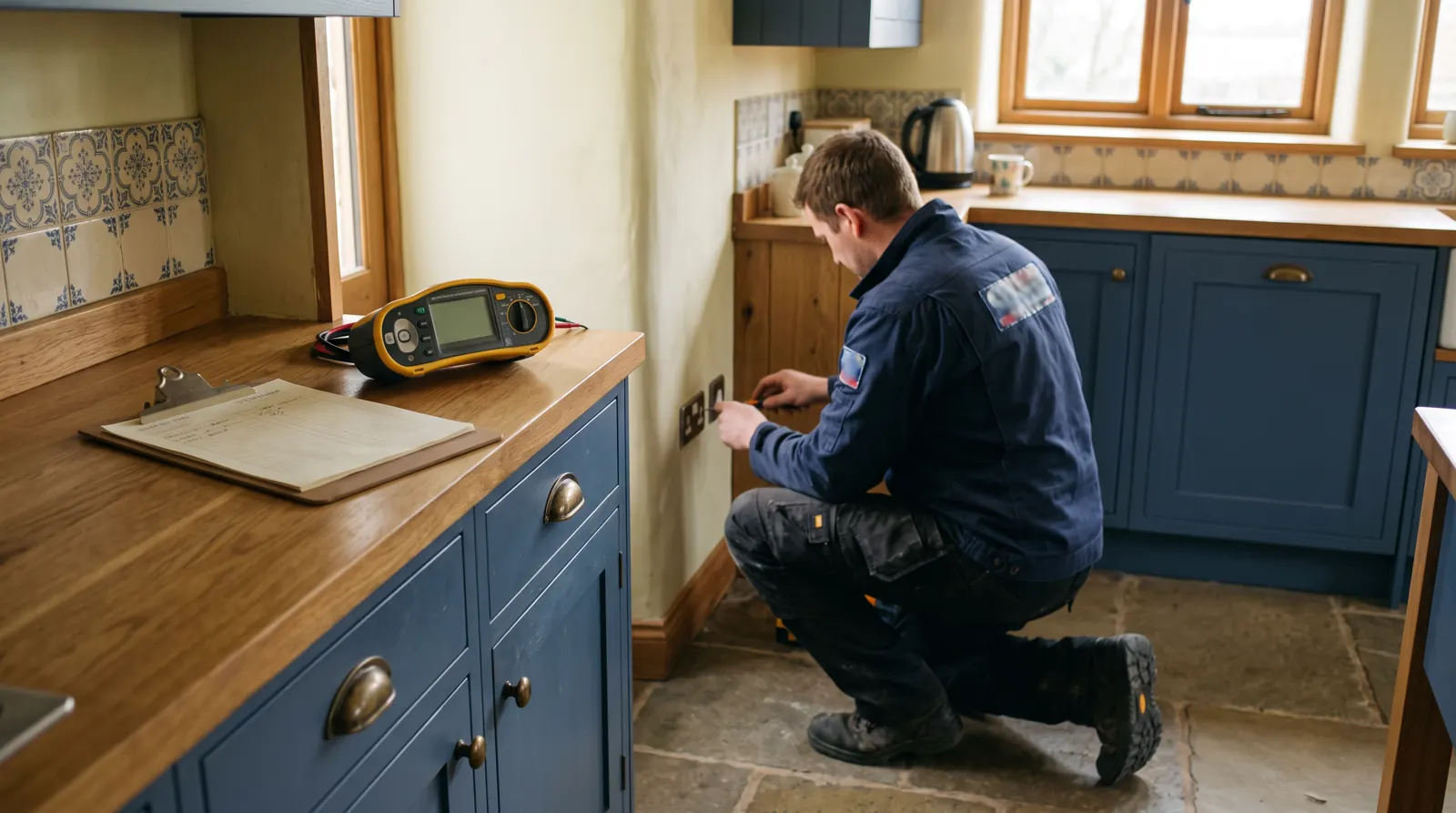
Our circuit tracing uses approved test instruments to check continuity, polarity, insulation resistance and earth-fault loop impedance, with supplies safely isolated before intrusive testing. We’ll examine lamp holders, switches, junctions and terminals for loose conductors, corrosion or unsuitable connections. In older Maidstone homes, we’ll also assess cable condition and identify mixed wiring where accessible.
Fuse replacement is only appropriate after we’ve identified why protective equipment operated; fitting a larger fuse or repeatedly resetting a device is unsafe and non-compliant.
What it costs to put right
We’ll diagnose the circuit to find the cause of flickering lights and provide a written quote; diagnostic time is charged at £80 per hour and most faults are found within one to two hours. We’ll isolate the issue, test connections and confirm any repair meets relevant safety requirements.
| Job | Price | What’s included |
|---|---|---|
| Fault finding | £80/hr | Labour, testing, VAT |
| Extra socket | £55–£75 | Parts, labour, testing, certificate, VAT |
| Consumer unit replacement | £500–£700 | Parts, labour, testing, certificate, VAT |
| Partial rewire | £1,200–£3,000 | Parts, labour, testing, certificate, VAT |
Not included: plaster repairs, decoration, asbestos removal or access equipment.
When it is an emergency instead
Flickering may indicate an emergency if it is accompanied by burning smells, crackling, heat at a switch or light fitting, smoke, sparks, repeated tripping at the consumer unit, or a loss of power affecting more than one circuit. Do not keep resetting protective devices or attempt to investigate live equipment yourself. If there is smoke, visible fire, or an immediate risk of electric shock, evacuate immediately, call 999, and do not re-enter until the emergency services confirm it is safe.
Where it is safe to do so, emergency isolation means switching off the main switch at the consumer unit without touching damaged, wet or hot equipment; if you are unsure how to do this safely you should not attempt it. Keep clear of affected fittings and cables and do not use the circuit. We offer a 24-hour emergency line and can attend to identify the fault, make the installation safe, and carry out any required testing before circuits are returned to service.
Correction: It is commonly thought that homeowners are legally required to isolate a circuit after any electrical fault; this is not a general legal duty—your obligation is to take reasonable steps to prevent harm (for example, switching off obviously dangerous equipment and calling emergency services or a qualified electrician).
Older wiring around Maidstone
In Maidstone we commonly see flickering lights caused by ageing cable insulation, loose terminations or unsuitable past alterations rather than a faulty lamp alone. In Victorian terraces around Tovil and in the town centre — many houses built in the mid-to-late 19th century — you can still find rubber-insulated or VIR cable runs. In parts of the post-war estates such as parts of Loose and the Grove Green area, where many homes date from the 1940s–1960s, aluminium conductors are sometimes present and will need a specialist assessment.
When we work in Maidstone we’ll inspect the specific circuit, the consumer unit serving that property, the earthing arrangement and local connections, and then test for deterioration, overheating and voltage drop in accordance with BS 7671. In older properties in areas like Barming or East Farleigh with houses from the late 19th to early 20th century we take a proportionate approach: we will trace faults and replace unsafe sections while aiming to minimise disturbance to original fabric such as cornices, exposed floorboards or sash window surrounds. Where a property in Maidstone is listed — for example parts of the High Street conservation area — the borough’s heritage conservation requirements may affect cable routes, chasing and the use of visible accessories.
If you have persistent flickering, scorching around switch plates, warm switches or buzzing in a property in Maidstone, do not ignore it; these symptoms can indicate a developing connection fault in homes typical of the town’s Victorian terraces or mid-20th-century estates. We will explain any remedial work specific to your Maidstone property and provide a fixed written price before work starts.